
 DE
DE  EN
EN 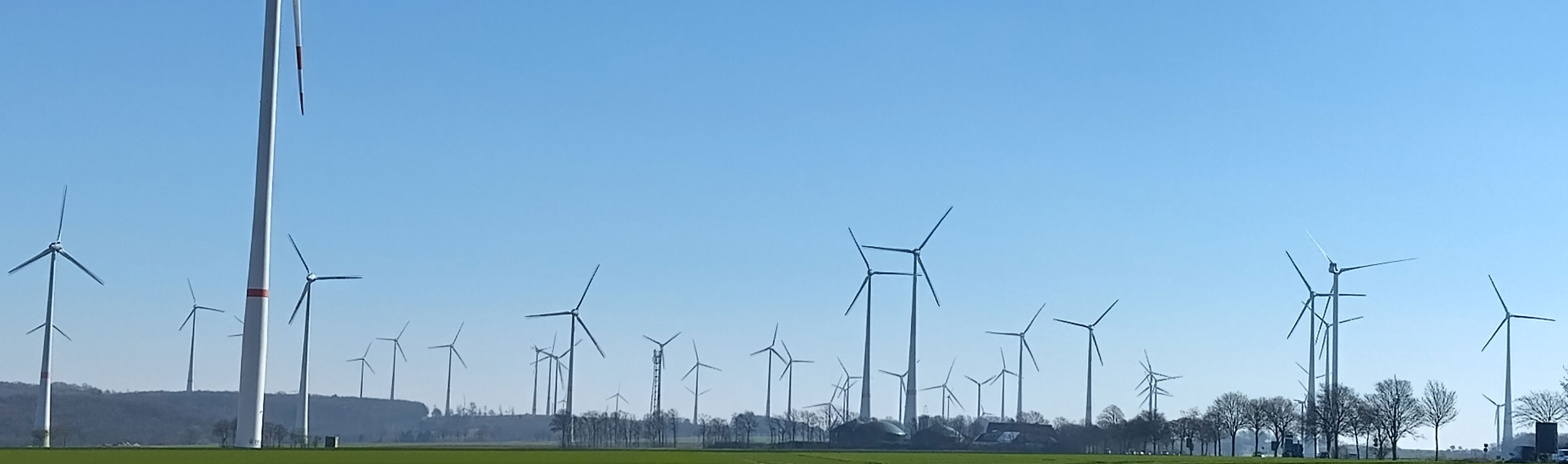
Wind is not a resource.
Sustainable.
Without alternative.
But hardly anyone asks the crucial question:
👉 What happens when we extract energy from the climate system itself on a large scale?
Because that is exactly what wind turbines do.
They do not generate energy — they only convert existing energy.
In doing so, they interfere with the global flow system.
A system that governs our weather, our water cycle, and our climate.
Wind is not a resource – wind is a system
Wind is neither superfluous nor simply “there.” It is nothing more than moving air, from which its kinetic energy arises.
It is created by:
- Solar radiation
- Temperature differences
- Pressure gradients
And it fulfills a central function:
👉 It transports energy and moisture across the entire planet. Wind is the transport system of the climate.
Thus, wind is:
- the driver of the global water cycle and weather
- the carrier and distributor of thermal energy
- the force behind waves on the ocean
Anyone who uses wind is not just using energy — they are altering a system.
What Wind Power Really Does
Wind turbines extract kinetic energy from the wind.
This means, in concrete terms:
- Airflows are slowed down
- Energy flows are altered
- Flow structures are disrupted
👉 Behind every wind turbine, an “energy shadow” forms — growing larger the more energy is extracted.
A zone with less wind, less energy, and altered dynamics.
An example:
The kinetic energy of wind is calculated using the following formula:

Let us assume:
- Air density: ρ ≈ 1.2 kg/m³
- Wind speed: 10 m/s
- Area: 1 m²
👉 This results in a volume flow of 10 m³/s and a mass flow of 12 kg/s.
According to the formula above, this yields a power density of 600 W, i.e. 0.6 kW per second.
This may sound small — and it is indeed the reason why wind turbines are built so large. However, when large air masses are involved, this adds up to enormous energy flows.
In reality, only about 30–40% is converted into electrical energy. The rest is dissipated through friction and turbulence.
Wind Power Output
For wind turbines, the following relationships apply:

Rotor diameter and wind speed are key factors for rated power:
- Double diameter → 4× power
- Double wind speed → 8× power
- Triple wind speed → 27× power
The term “renewable energy” creates the impression that energy can be renewed.
In reality, energy can only be converted. Even if wind is available again the next day, it is not “renewed” energy, but newly supplied energy.
Intervention in Water Transport
Example: Vestas V172-7.2 MW
- Rotor diameter: 172 m
- Rotor area: approx. 23,200 m²
Assumed wind speed:
Reduction from 14 m/s to 7 m/s
Air volume flow:
23,200 m² × 7 m/s = 162,400 m³/s
Water content of approx. 15 g/m³ air:
162,400 m³/s × 15 g/m³ =
2,436,000 g/s =
2,436 kg/s ≈ 2.436 m³/s
= 146 m³/min or 8,770 m³/h
Per day:
8,770 m³/h × 24 h = 210,480 m³
A Taboo in the Energy Debate?
CO₂ is discussed intensively.
Energy flows in the atmosphere hardly at all.
Yet physics is clear:
👉 Energy that is extracted is missing from the system.
And this is happening — on a large scale.
In Europe alone, hundreds of terawatt-hours are generated annually from wind.
👉 This corresponds to the continuous extraction of enormous amounts of energy from the atmosphere.
The question is not whether this has an effect.
👉 The question is: what effect does it have?
Scale of Energy Production
Europe:
- 2023: 428 TWh → approx. 49 GW average power
- 2024: 475 TWh → approx. 54 GW
→ roughly equivalent to ~50 large power plants
Worldwide:
- 2023: 2,304 TWh → approx. 263 GW
- 2024: 2,494 TWh → approx. 285 GW
→ roughly equivalent to ~250 large power plants
Assuming an average efficiency of about 30%, the actual impact on wind movement is approximately three times the electrical output.
Distribution of Wind Turbines
Most wind turbines have been installed in the Northern Hemisphere, largely in the climatically temperate Ferrel cell. On a global scale, a large share of wind energy is extracted in the Ferrel cell in both the Northern and Southern Hemispheres.
This may also explain why “Europe is warming faster than all other continents.”
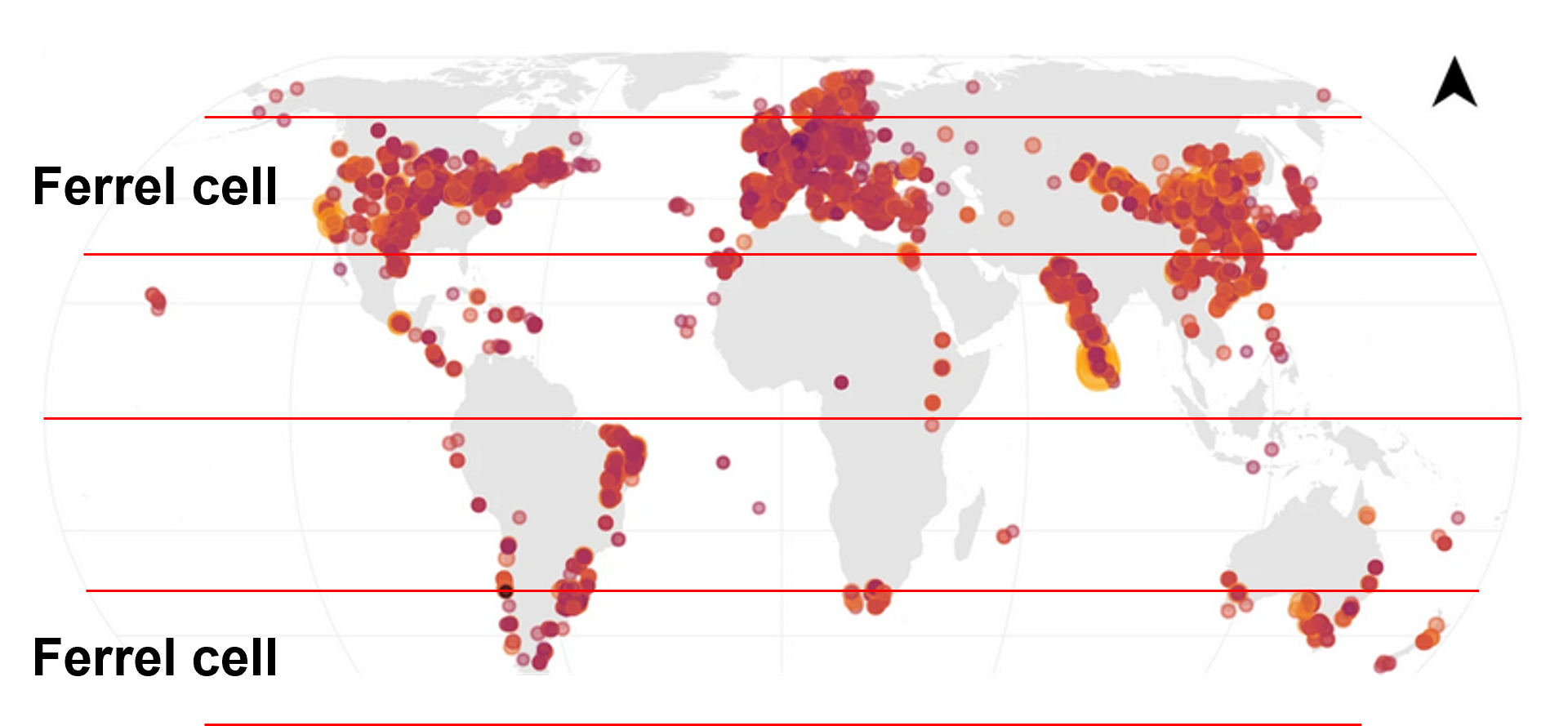
The graph (2020!) shows the accumulation of locations where energy is extracted from the tropospheric wind system (source: https://www.nature.com/articles/s41597-020-0469-8
Possible consequences – logical, not ideological
If wind is a transport medium, then:
Less wind = less transport
Possible consequences:
- altered moisture transport
- shifts in precipitation patterns
- changes in flow systems
- regional climate effects
👉 These relationships are physically plausible — but have so far been insufficiently studied.
The blind spot of the energy transition
Wind energy is described as “renewable.”
However, from a physical perspective, this is misleading — if not outright incorrect.
👉 Energy is not renewed.
👉 It is converted — and extracted from the system.
In the case of wind energy, this means:
👉 Energy is removed from the atmosphere.
And thus from one of the most sensitive systems on our planet.
Conclusion
Wind is not an isolated energy source.
Wind is part of a highly complex balance of:
- energy
- motion
- water
Anyone who uses wind energy intervenes in this balance.
Not locally.
But systemically.
👉 The key question is therefore not: Is wind energy good or bad?
👉 But rather: Do we truly understand the consequences of our actions?
Further Reading
- Atmosphere
- Air pressure and temperature explained
- Global Water Circle
- Solar energy
- Wind and Weather
- Greenhouse - Yes or No?
- The book about wind power and climate