
 DE
DE  EN
EN 
The Global Water Cycle Explained Simply
The global water cycle is a central component of the Earth's climate system. It describes the continuous movement of water between the oceans, the atmosphere, and land surfaces.
These processes influence weather, temperature, and the distribution of precipitation worldwide.
The Main Components of the Water Cycle
The water cycle consists of several interconnected processes:
- Evaporation
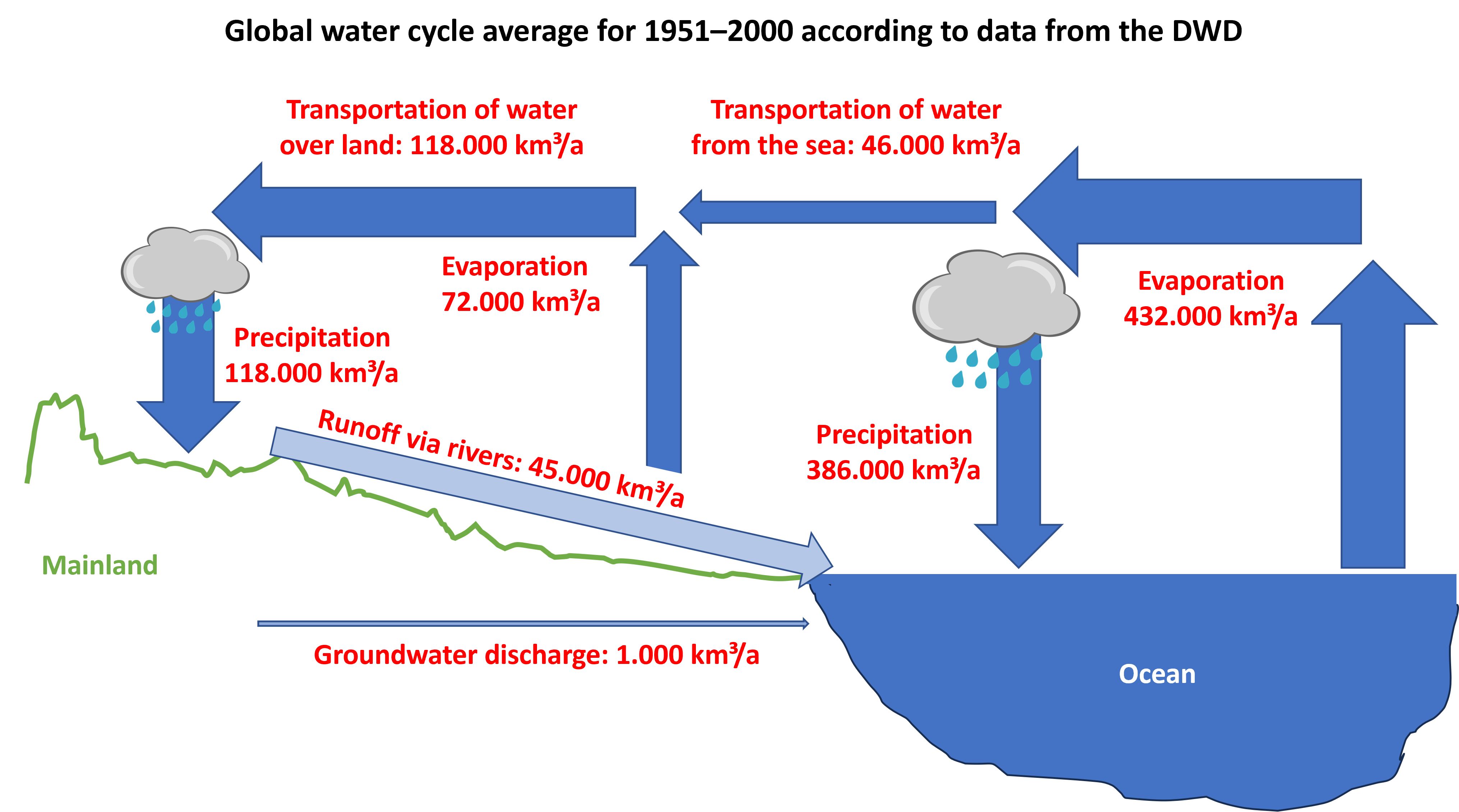
Around 500,000 km³ of water evaporate each year from oceans, lakes, and soils and enter the atmosphere as water vapor. - Transpiration
Plants release water into the air through their leaves for cooling. - Condensation
Water vapor cools at higher altitudes and forms clouds. - Precipitation
Water falls back to Earth as rain, snow, or hail. - Runoff and Infiltration
Water flows into rivers or infiltrates into the ground.
These processes occur continuously and are closely linked to energy flows in the atmosphere. The process of evaporation requires large amounts of thermal energy, which is stored in the water vapor. During condensation in clouds, this energy is released as latent heat.
( © Brugger, 2025)
Importance for the Climate
The water cycle plays a decisive role in the climate system:
- Transport of thermal energy (around one third of incoming solar energy is redistributed via the water cycle)
- Regulation of temperatures
- Influence on regional and global weather systems
- Formation of clouds and precipitation
Changes in the water cycle can therefore have direct impacts on the climate.
Energy and Air Movement
The movement of water in the atmosphere is closely linked to airflows.
Key relationships:
- Evaporation removes thermal energy from the surface
- Condensation releases this thermal energy in the atmosphere
- Air movements transport moisture over large distances
These processes are interconnected and influence each other.
Regional Differences
The water cycle is not the same everywhere:
- Tropical regions: high evaporation and heavy precipitation combined with relatively constant temperatures
- Arid regions: low humidity and little precipitation combined with high daytime temperatures (deserts)
- Temperate zones: more balanced conditions
Even small changes can amplify regional effects. Only about 8–10% of the water evaporating globally over the oceans reaches land as precipitation. Roughly one third of rainfall over land originates from evaporation from the oceans, while the remaining two thirds result from evaporation over land surfaces themselves.
Differences in evaporation and precipitation arise from the unequal distribution of land and sea, mountain barriers, and atmospheric circulation patterns. The Atlantic, for example, is considered a region of net moisture deficit in terms of evaporation, whereas the Pacific, due to its vast tropical water surfaces, is regarded as a region of moisture surplus.
Possible Influencing Factors
The water cycle is influenced by various factors:
- Solar radiation
- Temperature
- Vegetation
- Airflows
Interventions in natural circulation systems are also discussed in research. Plants and oceans are the largest sources of evaporation.
Connection with Wind Energy
Wind is generated by pressure differences in the atmosphere and is closely linked to the transport of heat and moisture.
Therefore, research is examining:
- whether and how changes in airflows may intensify local effects
- how large-scale interventions could affect the distribution of moisture
- how large-scale interventions could influence temperatures
These questions are part of ongoing scientific discussions, and many aspects remain unresolved.
Conclusion
The global water cycle is a complex and dynamic system. It links energy, air movement, and water transport and plays a central role in weather and climate.
A basic understanding of these processes helps to better interpret climatic relationships. It is also essential for understanding and assessing the impacts of interventions in natural circulation patterns.
Further Reading
- Atmosphere
- Air pressure and temperature explained
- Solar energy
- Wind and Weather
- Wind energy
- Greenhouse - Yes or No?
- The book about wind power and climate