
 DE
DE  EN
EN 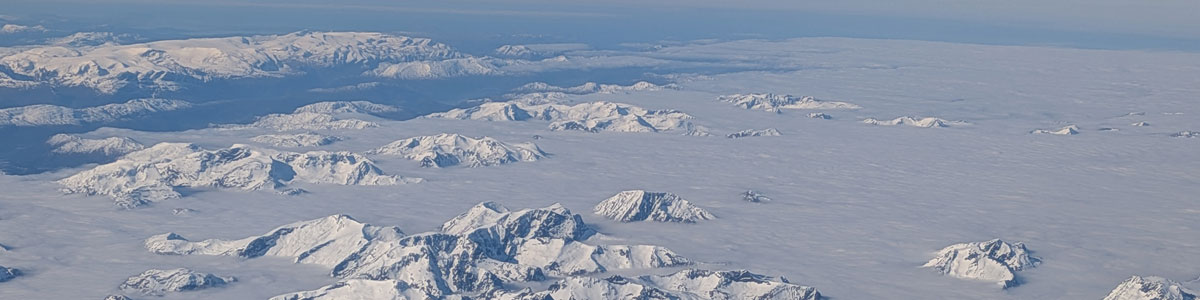
Above the clouds: View from 8,000 m altitude over the snow-covered Norwegian mountains between Ålesund and Oslo. (© Brugger April 2026)
This page explains why the classical greenhouse model describes only a small part of Earth’s climate system and highlights the crucial roles of scattering, convection, air pressure, water vapour and the global water cycle. It shows that the atmosphere is not a greenhouse but a dynamic flow and energy‑transport system.
Is the Earth a Greenhouse – Yes or No?
The short answer: No.
And that is a good thing.
The crucial question, however, is: Why was the greenhouse hypothesis proposed—and what is the physical explanation behind it?
And this is exactly where it becomes interesting.
What is undisputed
Solar radiation continuously reaches the Earth’s atmosphere. Part of it is reflected, while another part is absorbed by clouds, particles, and water vapor. A key role is also played by the scattering of light within the atmosphere.
Through scattering by air molecules—especially Rayleigh scattering—shortwave radiation is preferentially distributed in all directions. As a result, the entire airspace is, in a sense, “filled with light,” and the sky appears blue.
Without these scattering processes, there would be no uniformly illuminated sky. Instead, we would be looking into a black void, with a glaring sun as the only significant light source.
If the composition of the atmosphere changes—for example due to water vapor, dust, or aerosols (smog, Saharan dust)—the scattering behavior also changes. The proportion of longer-wavelength radiation increases, and the light becomes more diffuse:
⇒ The sky appears hazy, milky, or gray. Even the red colors of sunrise and sunset can be explained by these physical processes.
The Earth rotates—and with it, (figuratively speaking) a vast band of solar energy moves around the globe once per day. While one half of the atmosphere is exposed to radiation and heated, the other half remains in shadow and cools down.
This creates a continuous cycle of warming (radiative forcing from the Sun) and cooling (radiative emission from the Earth), which acts like a driving force that keeps the air in motion and powers our weather. The incoming and outgoing heat fluxes involved are enormous. More on this here.
What follows from this
These processes show:
The atmosphere is an active medium in which radiation and energy are continuously transformed and spatially redistributed.
⇒ What is crucial:
Solar energy does not reach the Earth’s surface only directly, but to a significant extent indirectly as diffuse radiation.
This makes it clear:
Even at this fundamental level, the climate system is not a simple radiative equilibrium, but a complex interaction of:
- Radiation
- Scattering
- Absorption
- and spatial redistribution of energy
⇒ And this is the decisive point:
Anyone who wants to understand the climate system must consider more than just radiative balances.
It must also be emphasized that we do not live under a “glass dome” like in a greenhouse. The “blue sky” is primarily an optical phenomenon. It cannot retain energy in the form of thermal radiation, regardless of direction or wavelength, like a solid enclosure (cf. the rapid temperature drop during clear, cold nights).
Where the Classical Greenhouse Explanation Falls Short
The common explanation of the greenhouse effect focuses primarily on radiative processes: Solar energy reaches the Earth, is converted into heat, and is partly emitted again as infrared radiation. “Greenhouse gases” absorb part of this thermal radiation and re-emit it—according to the theory, also back toward the Earth’s surface. Water vapor is also considered a greenhouse gas within this framework.
⇒ This principle appears physically correct.
But: it describes only part of the system.
The Climate System Is Not a Pure Radiation Model
In many simplified representations, the impression is created that climate can essentially be explained by a radiative equilibrium.
In reality, however, the atmosphere is a highly dynamic flow system in which energy is transported through very different mechanisms:
- Convection (rising and sinking air masses)
- Latent heat (evaporation and condensation of enormous quantities of water)
- Advection (horizontal transport of energy and moisture by wind)
⇒ These processes are not secondary—they are fundamental and central.
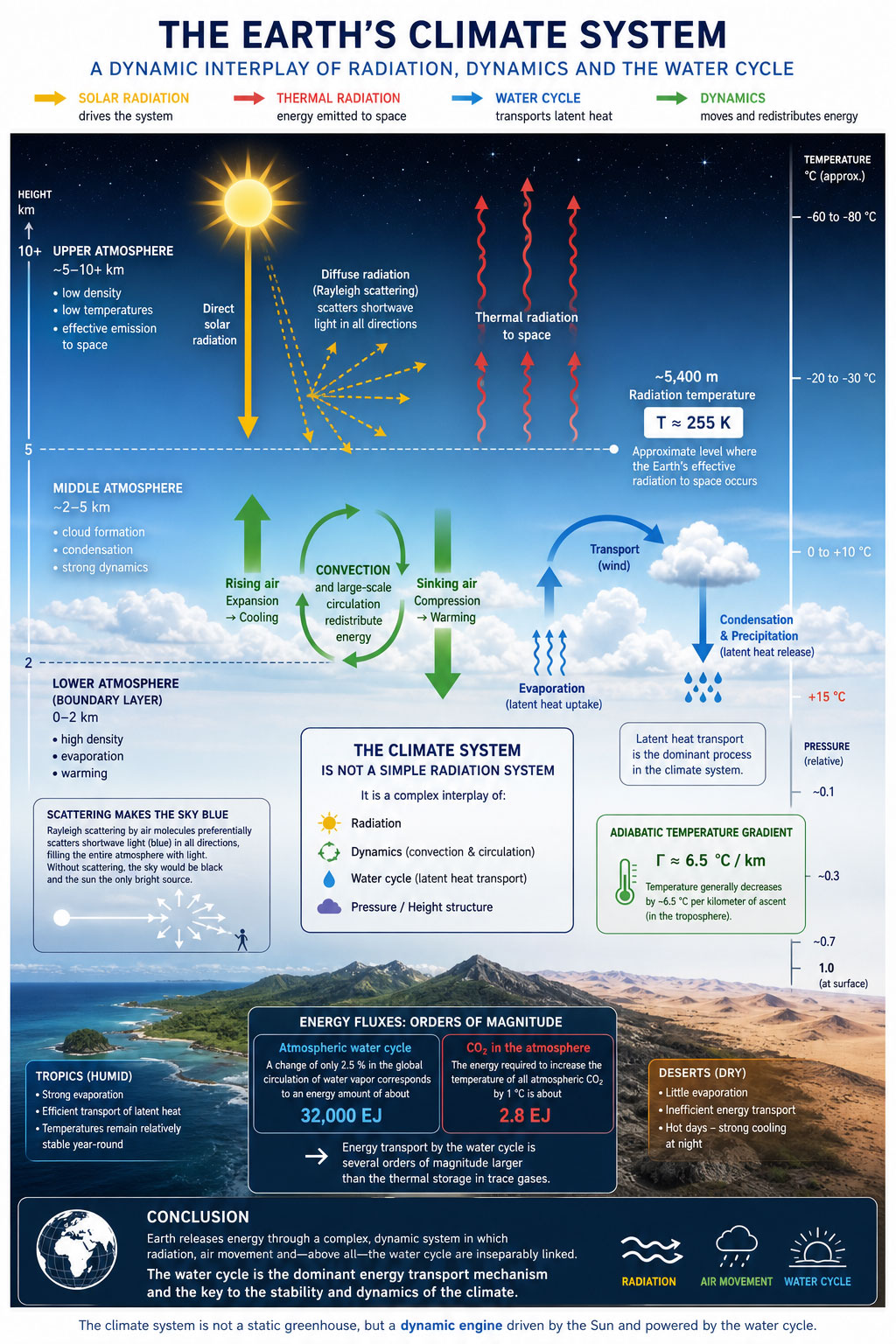
The Earth´s Climate System.
(© Brugger 2026)
Significance, Calculation, and Interpretation
Earth’s Radiation Temperature
A key reference value in climate physics is the so-called radiation temperature of the Earth, commonly given as about 255 K (−18 °C). This value also forms the basis of the greenhouse hypothesis.
⇒ Reason to examine it more closely:
A temperature of 255 K approximately corresponds to conditions at an altitude of about 5,400 m above sea level. This is the region of the atmosphere where roughly 50% of the air mass lies below and 50% above. For context: The mass of the Earth's atmosphere is approximately 5.1 × 10¹⁸ kg.
The radiation temperature at this altitude reflects the mean atmospheric temperature, not the “surface temperature” of the Earth. Moving downward from this altitude toward the surface, air mass and air pressure increases—and with it temperature: at sea level, this results in an average pressure of about 1,013 hPa and a temperature of 288 K.
And this without invoking any “Greenhouse Gases.”
⇒ More on the relationship between air pressure and temperature and its calculation here.
The frequently cited radiation temperature of 255 K therefore demonstrates neither the simplicity of the system nor the greenhouse effect, but rather the complexity of the atmosphere. It shows that the Earth does not radiate directly into space from its surface, but through a several-kilometer-thick atmospheric layer.
This crucial point is often insufficiently considered—or entirely neglected—in simplified climate representations.
What Follows from This:
- The atmosphere is not a static heat blanket
- It is a vertically structured, dynamic system
- Energy exchange occurs not only through radiation, but also through convection, phase changes of water, and air movement
This makes it clear:
The widely spread idea that the Earth’s surface simply warms due to “back-radiated heat” falls short. In reality, it is a complex interaction of radiation, compressional heating, temperature decrease with altitude, air pressure, water vapor, cloud formation, oceans, and atmospheric dynamics.
The Underestimated Dominant Process
⇒ The climate system is not primarily regulated by radiation, but by the water cycle.
Evaporation, transport of water vapor, and condensation are central processes of the global energy balance. Enormous amounts of energy are stored, transported, and released—not as sensible heat, but as latent heat.
This mechanism acts like a global balancing system:
- Energy is absorbed at the surface (evaporation)
- Transported over large distances (atmosphere/wind)
- Released elsewhere (condensation, cloud formation)
⇒ This process plays a decisive role in stabilizing the climate.
A clear illustration can be seen in the comparison between the tropics and deserts:
Despite very high solar radiation, temperatures in the tropics remain relatively stable throughout the year. The reason is not a lack of energy input, but a highly efficient removal of energy via the water cycle (Rainforests).
In contrast, dry deserts experience extreme temperature variations: very hot during the day due to solar radiation, and strong cooling at night.
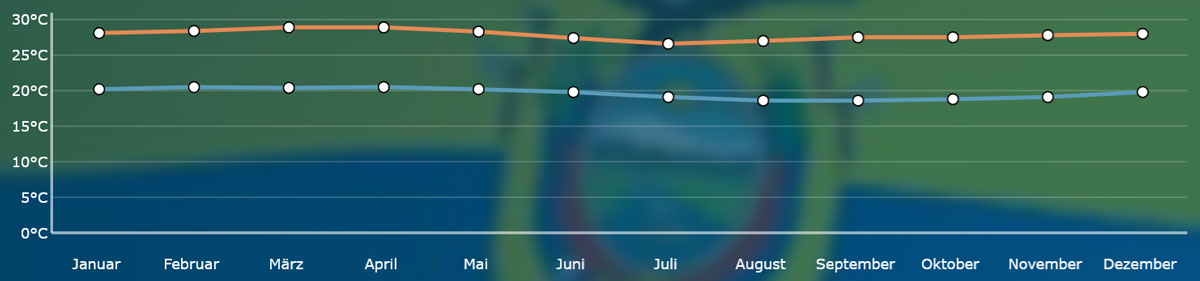
(Average temperature profile Ecuador — Source: https://www.laenderdaten.info/Amerika/Ecuador/Klima.php)
Orders of Magnitude of Energy Flows
To understand the significance of these processes, it is useful to consider the scale of energy flows in the water cycle:
- Approximately 13,000 km³ of water are present in the atmosphere. Multiplied by the latent heat of evaporation, this corresponds to about 32,000 exajoules (EJ) of latent heat.
- Atmospheric water is cycled 38 to 39 times per year, corresponding to a heat transport of roughly 1,250,000 EJ—about one-third of the annual incoming solar energy.
- Even a very small change in global water vapor circulation—e.g., only 2.5%—would mean that approximately 32,000 EJ of energy is no longer transported from the Earth’s surface into the atmosphere.
In comparison:
- To increase the temperature of all atmospheric CO₂ by 1 °C would theoretically require about 2.8 EJ of energy.
⇒ These figures clearly show:
Energy flows associated with the water cycle are orders of magnitude larger (factor ~11,000) than the purely thermal storage capacity of trace gases.
Conclusion
What follows from this?
⇒ The Earth releases its energy through a complex, dynamic system in which:
- Radiation
- Air movement
- and, above all, the water cycle
are inseparably linked.
The commonly simplified representation of the greenhouse effect therefore falls short when it focuses primarily on radiative processes.
⇒ The decisive factor for the stability and dynamics of the climate is the water cycle as the dominant energy transport mechanism and the wind is an essential component of this system.
Further Reading
- Atmosphere
- Air pressure and temperature explained
- Global Water Circle
- Solar energy
- Wind and Weather
- Wind Energy
- The book about wind power and climate