The layer of air that surrounds our planet is called the atmosphere. Although we are constantly immersed in it, rely on it for breathing, and experience nearly everything important to us within the lowest 1 to 1.5 per mille of its roughly 10,000-kilometre height, most people have only a vague idea of what the atmosphere actually is. Few know which processes take place within it or how crucial it is for Earth’s climate and temperature.
How is the atmosphere structured?
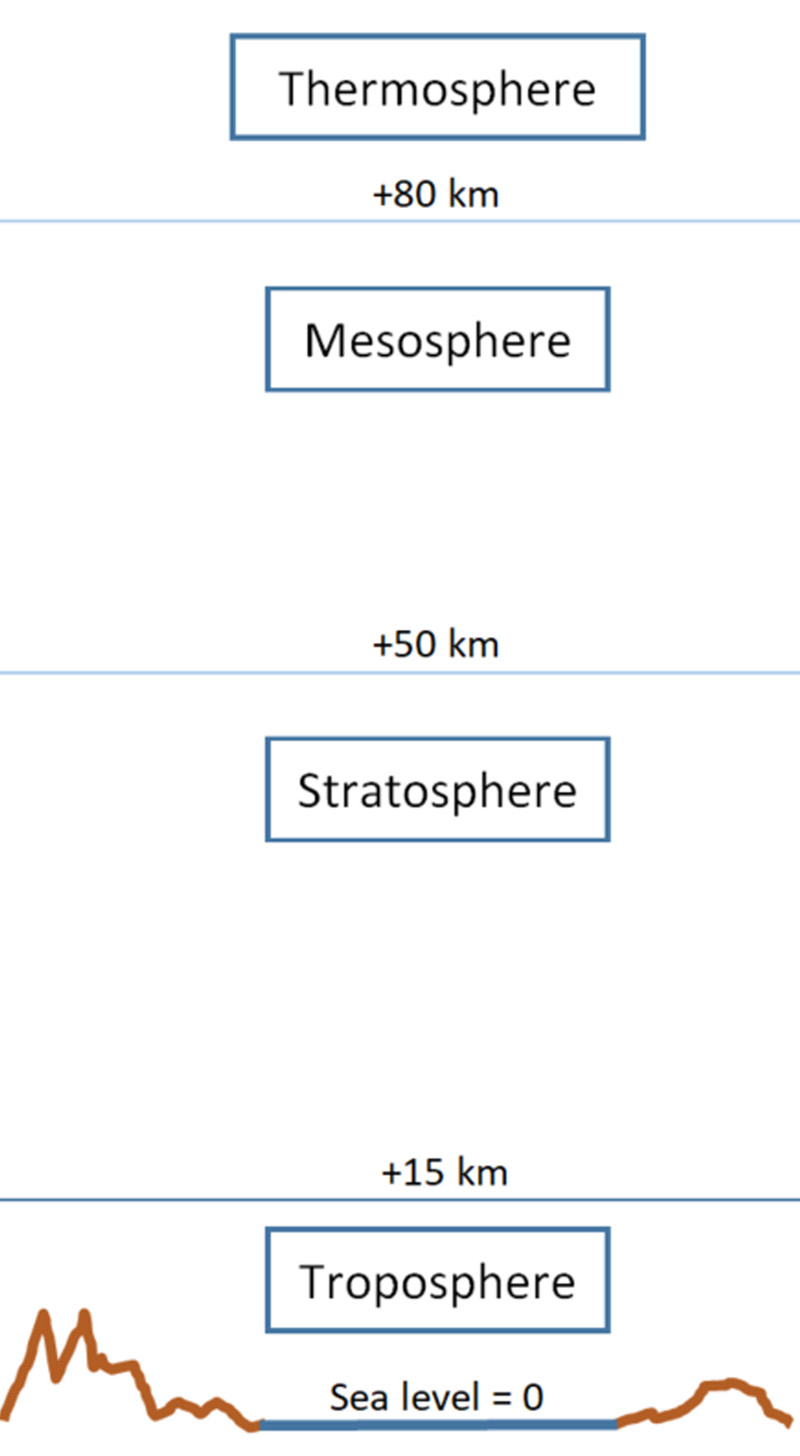
If you type “structure of the atmosphere” into an image search engine, you will quickly find countless illustrations. Most of them show the atmosphere divided into colourful layers, and they usually use a highly distorted scale. As a result, these images can give a misleading impression of what the atmosphere really looks like.
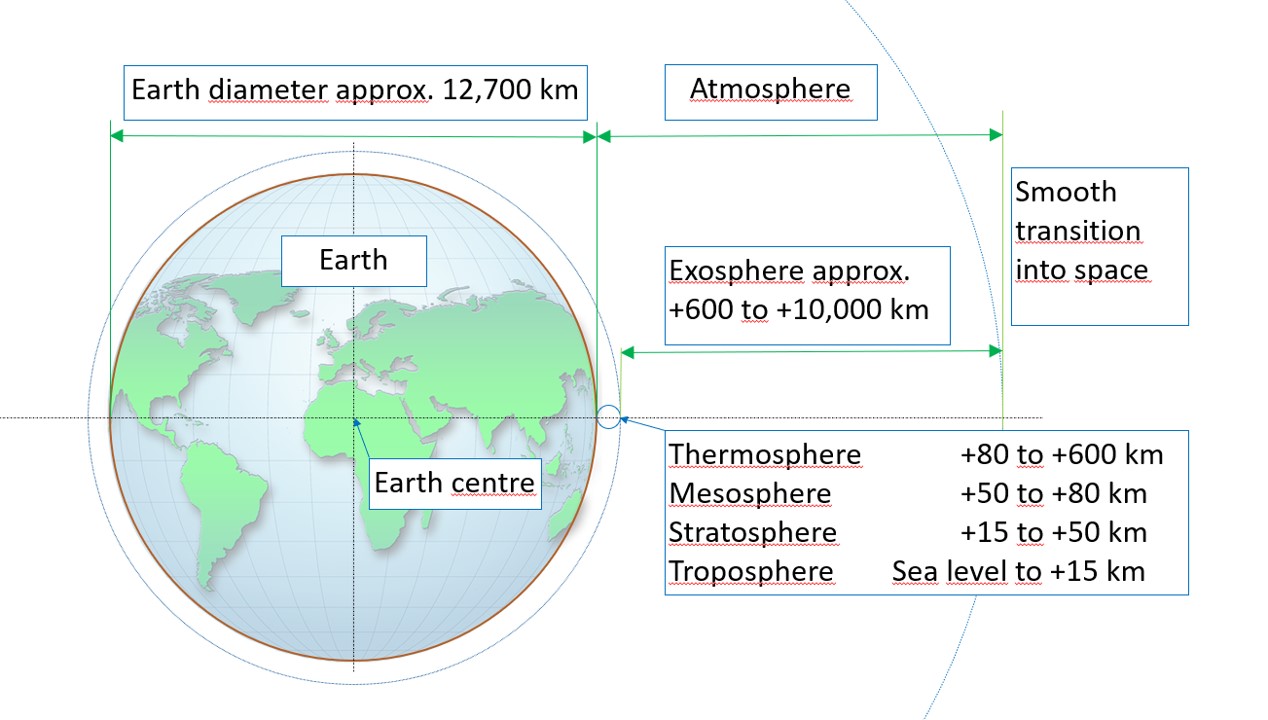
When the true proportions are taken into account, a very different picture of the atmosphere as a whole emerges:
(© Brugger, 2023) |
1. Exosphere
The exosphere is the outermost and most spatially extensive layer of the atmosphere. It begins at an altitude of approximately 600 kilometres and extends to around 10,000 kilometres, where it gradually merges into interstellar space. In this region, almost all gas molecules are ionised. The gas density is extremely low, and the few remaining particles move at high speeds and are separated by great distances.
In theory, temperatures well above 1,000 °C would prevail here, but only if there were enough matter to absorb electromagnetic radiation and convert it into heat. Thus, although the exosphere by far represents the largest portion of the atmosphere by volume, it contains only a tiny fraction of the total atmospheric gas mass.
2. Thermosphere
Below the exosphere lies the thermosphere. It extends from about 80 km to roughly 600 km above Earth’s surface. The air density is still very low, and theoretical temperatures range from around 300 °C at night to about 1,500 °C during the day—conditions comparable to those in the exosphere.
In this layer, spacecraft and satellites such as the Space Shuttle and the International Space Station (ISS) orbit the Earth.
|
3. Mesosphere
The mesosphere extends from approximately 50 to 80 kilometres above sea level. Here, the gas density gradually increases but is still only about one per mille of the air density at sea level. Nevertheless, this low density is sufficient to cause smaller meteorites entering Earth’s gravitational field at high speed to burn up due to friction—visible to us as shooting stars.
Temperatures in the upper regions of the mesosphere can drop to as low as −100 °C, making it the coldest layer of the entire atmosphere.
4. Stratosphere
The stratosphere lies between about 15 and 50 km above sea level. In this layer, the temperature rises from approximately −80 °C at the tropopause (the boundary close to Earth) to around 0 °C at the stratopause (the boundary farther from Earth). The stratosphere contains the ozone layer, which is vital for life and responsible for the increase in temperature within this region.
High-energy UVC radiation (100–280 nm) splits oxygen molecules (O₂) in the air. The resulting oxygen atoms then combine with other oxygen molecules to form unstable ozone molecules (O₃). In the resulting layer, known as the ozone layer, a large portion of the Sun’s intense ultraviolet radiation is absorbed and converted into kinetic energy and heat. This process protects our habitat in the troposphere from excessive and harmful UV radiation.
The ozone layer reveals the first apparent anomaly of the atmosphere. Ozone is about one-third heavier than oxygen and, with a density of 2.15 kg/m³, significantly heavier than air, which has a density of about 1.29 kg/m³. In theory, ozone should sink downward under Earth’s gravitational pull, but in reality it does not. The most likely explanation for this behaviour is the temperature increase caused by the absorption of high-energy UVC radiation by ozone molecules.
This radiation raises the internal energy of the molecules by exciting stronger vibrations and rotations before the energy is released again as electromagnetic radiation. Taking these processes into account, ozone changes its role—from a greenhouse gas to a protective gas, at least within the stratosphere.
5. Troposphere
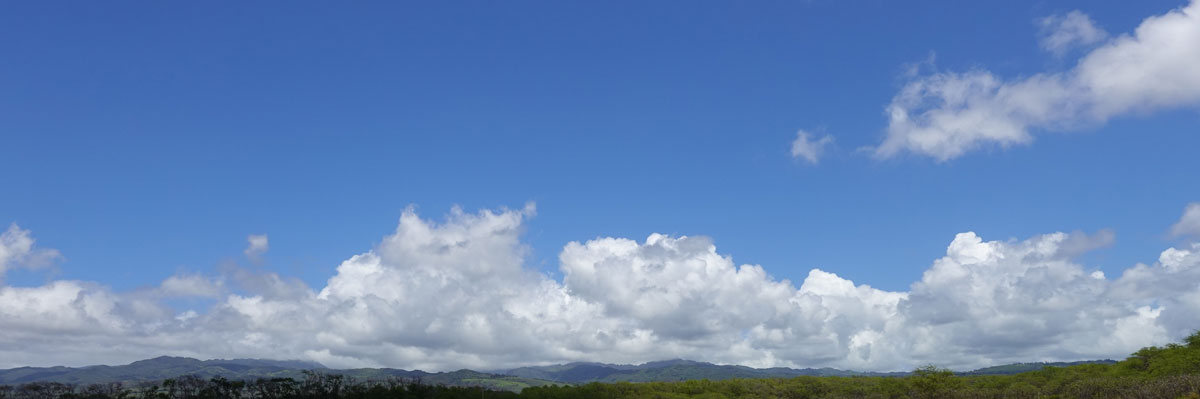
Although the troposphere is the thinnest atmospheric layer, at about 8 to 15 km, it contains almost all of the atmosphere’s water vapour and around 85 % of its total air mass—a relationship that can be easily understood using the barometric height formula. It is the layer in which we live and therefore our actual habitat.
The troposphere receives its heat primarily from the Sun. With increasing altitude, the gas mass—and thus the temperature, depending on humidity—decreases by about 6.5 to 10 °C per 1,000 m, dropping to around −80 °C at the tropopause. As a general rule, the drier the air, the greater the rate of cooling.
What does atmospheric air consist of?
The entire atmosphere is a continuous mixture of gases that is held close to Earth by gravity and becomes progressively less dense with increasing altitude. The atmospheric layers described above serve only to define spatial regions; they are not separate physical boundaries.
The main components of atmospheric air are:
-
nitrogen (78%
-
oxygen (20.8%),
-
trace gases such as the noble gas argon, methane, and ozone (1.16%),
-
carbon dioxide (0.04%),
-
and water vapour (humidity), which varies in concentration.
Where does air pressure come from?
As already explained, the atmosphere consists of various gases that are bound to the planet by Earth’s gravitational pull. Without this force, the gases would escape into space, which in fact happens to a very small extent via the exosphere.
Gases are compressible and obey the physical laws of gases. In a mixture, each gas occupies the entire available space, driven by entropy. If the atmosphere were not held in place by gravity, all gases would be evenly distributed and would have the same pressure and temperature everywhere—as illustrated by the left-hand column in the example without gravitational influence.
In reality, however, all gases are pulled toward Earth (right-hand column). Assuming that no energy exchange takes place (an adiabatic change of state), the air near the ground is compressed and its density increases, while at higher altitudes it is decompressed and its density decreases. These changes in state lead directly to warming in the compression zone and cooling in the decompression zone. They occur independently of the initial temperature; the vertical gradients of temperature and pressure are purely physical in origin.
Relationship between altitude, air pressure and gravity: |
The gases in the air generate air pressure through their weight. Or more precisely, through the sum of their partial pressures. In everyday life, we are generally unaware of this pressure. If the air neither moved nor heated up but remained static at Earth’s surface, the air pressure at sea level would be almost constant. The graph below does not take water vapour into account, as its proportion fluctuates greatly compared with the other gases.
Air pressure and CO2 content depending on altitude: |
The air pressure is therefore not constant. Its average value at sea level is p₀ = 1013 hPa (hectopascals). This corresponds to a pressure of approximately 10,000 kg/m² or the weight of a 10-metre-high column of water on an area of 1 m × 1 m.
Why does the temperature change with altitude?
At an altitude of just over 5,000 metres, the air pressure is already reduced by half, which means that around 50 % of the total air mass lies below this height. The lower oxygen availability is clearly noticeable when breathing, especially during physically demanding activities such as mountain hiking or climbing. To absorb the same amount of oxygen, approximately twice as much air must be inhaled at this altitude. This leads to shortness of breath and an increased breathing rate.
The reason for the decrease in temperature is the declining air density with increasing altitude. In a static air column, pressure decreases from bottom to top without any exchange of energy. In other words, the number of energetically excited particles decreases with height, and as a result, so does the temperature.
The altitude that contains 50% of the atmospheric mass also corresponds to the level of Earth’s average radiation temperature—or, more precisely, that of the gaseous envelope surrounding the planet—which is commonly given as 255 K. This value matches calculated results for humid air and is consistent with measurements made aboard aircraft (see below).
© Brugger, 2023 |
The strong influence of water vapour is also evident: humid air contains considerably more heat energy than dry air, which is why the temperature decreases less sharply with increasing altitude. The reason for this difference in behaviour is the latent heat stored in the water vapour.
Note:
The data and tables underlying the diagrams are available for direct download. Two curves were calculated for the air temperature: one for dry air (red line) with the isotropic exponent i = 0.286 and one for air with normal humidity (blue line) with i = 0.19. In the second case, water vapour, which was not previously taken into account, is included. See also the page ‘The global water cycle’ in the article Wind – invisible, mysterious and full of energy.
The values displayed by the on-board system during an approach to Frankfurt Airport show that the theoretical calculation for air with normal humidity corresponds well with actual measurements. The ground temperature was about 5–8 K above the 15 °C (288 K) underlying the blue curve. At altitudes above 10,000 m, the measured temperatures also indicate significantly drier air.
Air temperature as a function of altitude: |
Greenhouse effect and greenhouse gases?
How can the lower layer of the troposphere become warm and remain warm when temperatures of up to -80 °C already prevail at an altitude of approx. 15 km and warm air masses are known to rise? Many people have already addressed this question in lengthy treatises and put forward various theories, yet there is still no clear evidence for either theory to date.
All we need to do is look at the physics. As already explained above, the higher surface temperature of 288 K on Earth, in contrast to the average radiation temperature of 255 K, is due solely to the compression of air at normal humidity. The average radiation temperature corresponds to the average temperature of the 50 % cold and 50 % warm air masses in the atmosphere.
Neither a greenhouse effect nor greenhouse gases are necessary to explain atmospheric temperatures! A theory derived from observations and based on presumed ‘key theoretical findings’ (IPCC) is and remains only an unproven hypothesis. And a hypothesis does not become true simply because many people believe in it.
It is undisputed that the main source of temperature on Earth or the Earth's surface is solar radiation. It is also undisputed that this has been the case for billions of years and that a wide variety of climatic scenarios have occurred on Earth completely without human intervention and in a natural way. These climatic changes were extreme in scale and have nothing in common with the comparatively marginal fluctuations or changes in temperatures in the zero decimal range, which are generally referred to today as climate change.
All gases in the open air envelope behave similarly and store heat energy. The specific heat capacity of air is essentially determined by nitrogen, oxygen and water vapour. The additional water vapour acts as the main energy carrier (humid air). The specific heat capacity indicates how much heat energy is required to increase the temperature of a substance with a mass of 1 kg by 1 Kelvin. In terms of mass, the specific heat capacity of water is about four times higher than that of air.
However, the density of air at 1.29 kg/m³ is considerably lower than that of water at 1,000 kg/m³. In terms of volume, water can therefore store several thousand times more energy than the same amount of air. Or conversely: small amounts of water vapour in air store enormous amounts of heat.
Air is also a very poor heat conductor, which is why warm air must be moved, e.g. by convection or wind. Stagnant air can heat up significantly, which is why wind is essential for a balanced climate. It is also known from hair dryers and fan heaters that air cools down very quickly, no matter how hot it is. Air is also highly permeable to infrared radiation. If this were not the case, the sun's radiation would not reach the earth's surface.
Conclusion:
In summary, it can be said that the essential climatic events take place in the troposphere and here in the lowest altitude ranges of a few thousand metres above sea level (biosphere).
And this is precisely where humans intervene, extracting massive amounts of energy from the troposphere by means of wind turbines, on coasts, in wind corridors and on mountain ranges! The wind, together with water vapour and its distribution, is the essential climatic factor.
Further and more detailed information on the structure of the atmosphere, tropospheric weather cells (Hadley, Ferrel, Polar) and wind currents, as well as the global water cycle, can be found in the book Windwahn – Der Windwahn und seine klimatischen Konsequenzen.
DE
EN